Showing posts with label Pollution in river Ganga. Show all posts

Tuesday, September 2, 2014

Existence of Ganga in danger, says environment scientist Prof B D Tripathi

New Delhi: Existence of Ganga in danger, says environment scientist Prof B D Tripathi
New Delhi, June 8 2014: The existence of Ganga is in danger and the pollution of the river is a secondary issue, a renowned environment scientist has said and urged the NDA government to launch a “Save Ganga” programme.
B D Tripathi, an expert member of National Ganga River Basin Authority (NGRBA), also requested the Narendra Modi government to make active the Prime Minister-chaired body saying it was virtually non-existent during the UPA rule. “My observation on the basis of my research for the past four decades is that the problem of pollution is secondary and the main problem now is the existence of Ganga. It is in danger,” Tripathi told PTI.
“The mission should be called Save Ganga not Clean Ganga,” he said.
According to him, Ganga is facing a problem of what he termed as ‘triple three’. “They are reduced water flow, reduced water carrying capacity and reduced water quality that is pollution,” he said.
Blaming the “indifferent attitude” of the previous government for the failure of the Ganga Action Plan, Tripathi said that considering the Modi government’s seriousness on Mission Ganga, NGRBA should be made functional now.
“Being an expert member of NGRBA, I have raised this issue several times but the previous government had an indifferent attitude towards this cause that resulted in failure of various projects so far.
“There have been only three meetings of NGRBA in the past four years. Now since Narendra Modi himself has mission Clean Ganga on his priority list, so it is high time to make NGRBA functional,” he said.
Tripathi, also a coordinator for Centre for Environmental Science and Technology at the Banaras Hindu University, has been associated with the cause since 1972. The Centre has given Ganga the status of national river and constituted NGRBA in February 2009. The objective of the authority is to ensure effective abatement of pollution and conservation of Ganga by adopting a river basin approach for comprehensive planning and management.
“Government has declared Ganga as a national river but till now there is no policy or planning made in this regard. Ganga flows through five states (Uttarakhand, Uttar Pradesh, Jharkhand, Bihar and West Bengal) and they exploit it in their way,” Tripathi said.
“Centre gives 85 per cent of funds and rest 15 per cent is contributed by states but there has been no monitoring at any level. After five years, you come to know about the failure of the plan but who is accountable for that,” he asked.
He maintained that the Centre should see the problem in its entirety. “Almost Rs 1500 crore were spent on GAP 1 and projects amounting to Rs 20,000 crore are still running. Government must fix accountability and there should be monitoring after every three months. Monitoring committee should consist of technical experts,” he said.
Suggesting long term measures to address these problems, he said that there should be a complete
ban on construction of big dams at the source of its streams and usage of alternative power generating methods is must.
“Eight streams of Ganga originate from Gangotri glacier but the main ones are Bhagirathi, Mandakini and Alaknanda. All the proposed dams near the source should be cancelled. They can construct small dams,” he said.
According to Tripathi, the whole Uttarakhand region is low pressure zone where the wind velocity is very high so electricity can be generated through windmills like Europe. “As far as the reduction of ground water level is concerned, rainwater harvesting should be implemented strictly,” he suggested.


Saturday, May 17, 2014

Challenges of River Ganga before Narendra Bhai Modi

Recently during 16th Loaksabha Election the victory of Shri Narendra Bhai Modi has created a new history in India. Before going for nomination he told “ Maa Ganga ne mujhe bulaya hai” have shown his commitment towards mother Ganga. This was highly appreciated by the environmentalists, technocrats and the common masses because the life of 450 million people is threatened due to fragmentation of river Ganga.

Since, Modi ji has become Prime Minister of India and Chairman of the National Ganga River Basin Authority (NGRBA), I as an expert member of the NGRBA and pioneer scientist working on Ganga for last 42 years, would like to draw his attention towards the following challenges of river Ganga.

1.   Continuous decrease in the flow of water during past a few years has induced fragmentation of the National River Ganga and it has imposed a serious problem to the nation and threatened the lives of 450 million people.
2.    Decrease in the velocity and quantity of Ganga water has adversely affected its dilution factor rather self purifying capacity. Hence, without any further addition in the quantity of pollutants, the intensity of Ganga water pollution has been increased.
3.   Decrease in the flow of Ganga water is the probable reason by which all efforts made by the government during past a few decades to control the pollution of river Ganga has not been visualized.
4.  Mother Ganga is suffering with the “triple R” problem i.e. Reduced ecological flow, Reduced water carrying capacity and Reduced quality i.e. Pollution of water.
5. The problem of mother Ganga is the multidimensional problem, henceforth, only holistic approach can save the Ganga.


Since, mother Ganga is inseparable part of our life and its water is regarded as the most purifier of human body and soul science times immemorial, I would like to request Modi ji to keep aforesaid points in his mind before implementing any further projects to save mother Ganga. 

Prof. B.D.Tripathi, Expert Member, NGRBA, Govt. of India

Tuesday, May 29, 2012

Scientific Ganga Yatra

Near Hydro-power Project
Near Tehri Dam
A closer View of Tehri Dam
At Karn Prayag
View of Karn Prayag
Near KedarNath
Dry stretch of River Bhagirathi
Beautiful location of Yamunotri
River Mandakini: Peace of mind
Site View of river Alaknanda
Receding water table at Tehri Dam
Ganga at Rishikesh
Ganga at Gangotri

Monday, May 21, 2012

Special Report on Scientific Ganga Yatra in Uttarakhand


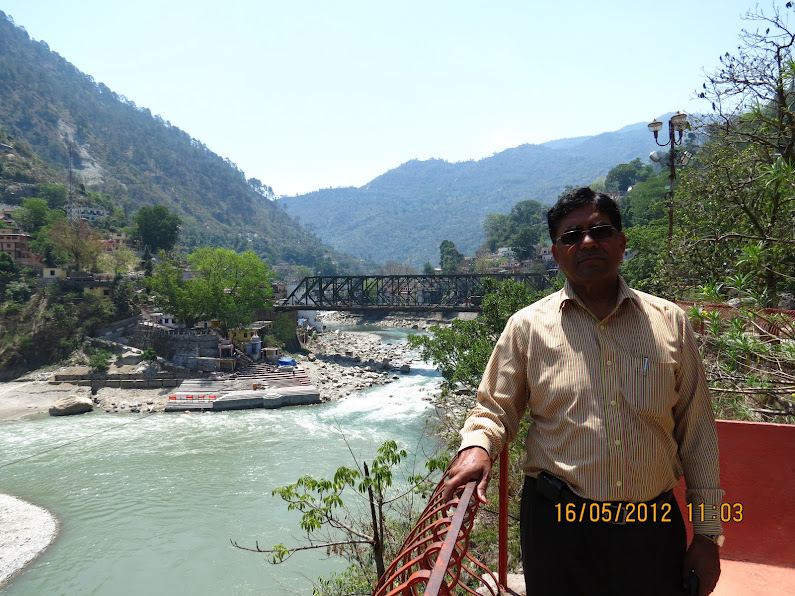
In view of the dedicated efforts of Hon’ble Prime Minister of India to Save Mother Ganga and related Social Movements, Prof. B. D. Tripathi of the Banaras Hindu University, who has pioneered Ganga Pollution Researches since 1972 and also Expert Member of the National Ganga River Basin Authority (NGRBA), has made an intensive GANGA YATRA in Uttarakhand and field based Ecological Study during the month of May 2012. He has visited river Ganga, Bhagirathi, Alaknanda, Mandakini, Pindar, Dhauli Ganga, Nandakani, Sone Ganga and river Yamuna in Uttarkhand. Prof. Tripathi has travelled across the Uttarakhand and spent day and night on the bank of various rivers for seventeen days. Dr. Tripathi has also visited Gangotri, Yamunotri, Badrinath, Kedar Nath, Deoprayag, Rudraprayag, Karnprayag, Nandprayag,Vishnuprayag,  Soneprayag, different Dams and Hydroelectric Projects etc. to study different anthropogenic activities and its impact on GANGA. The main aim of his study was to identify anthropogenically induced ecological problems of river GANGA in Uttarakhand, and suggest possible remedial measures to Hon’ble Prime Minister to overcome the problems of river GANGA and its important head streams, who are regarded as lifeline and worshiped as the mother in India. During Scientific Ganga Yatra, besides ecological investigation, Prof Tripathi has also met to the people who are dependent for their livelihood on these rivers, religious leaders, social activists, various scientific groups working on Ganga, noted environmentalists and those who were serious about the development of the Uttarakhand . He has made following important observations during his scientific Ganga Yatr
  1. Large number of hydroelectric power projects have been commissioned and proposed on river Ganga and Alaknanda, such as on river Ganga 16 hydroelectric projects have been commissioned, 13 projects are under construction and 54 projects are proposed. On river Alaknanda 6 hydroelectric projects have been commissioned, 8 projects are under construction and 24 projects are proposed.  
  2. Hydroelectric power projects are causing submersion of large land area which results in loss of flora and fauna. These hydro-power projects are altering natural rhythm of nature, sediment and nutrient regimes, temperature, chemical qualities of water, fresh water biodiversity and reproductive capabilities of aquatic animals. This also creates high hydraulic pressure at a given point of earth which may stimulate earth quake and landslides
  3. Construction of dams causes huge destruction of mountain ecosystem including reduction in the natural flow and dilution capacity of the river resulting enhancement of the pollution level
  4. The Tehari Dam has been constructed among the hills made up by the soil. This result in loss of 25-30% water of the reservoir through seepage and induce severe threat to the hills in the vicinity.
  5. In Uttarakhand, natural flow of majority of rivers has been obstructed by a series of hydroelectric power projects. At many places main path of these rivers have been diverted through the tunnels and upto several km main path of the river has been dried. This has not only destroyed the flora and fauna of the river stretch but badly affected the quality of water, human life and altered the structure and functions of the natural ecosystem. 
  6. The diversion of rivers has also created various socio-economic and religious problems to the local inhabitants. Their local resource based livelihood (such as agriculture, domestication of animals and religious activities) suffers significantly enhancing unemployment and poverty.
  7. The blasting activities in these hilly areas are causing huge cracks in the hills, loss of biodiversity, seepage of water and increased soil erosion responsible for siltation in the rivers.
  8. The observed high wind speed in the Uttarakhand due to low pressure belt creates suitable environment for the production of electricity through wind mills. The use of Wind mills may mitigate the negative impacts of the anthropogenic activities in these areas.
  9. Promotion of Wind mills for generation of electricity in Uttarakhand in place of hydropower projects which require huge land area and water, shall help in maintenance of the ecological flow of the river Ganga which is currently a burning issue in India and main objective of the NGRBA.